Key Points
- The median dental assistant salary is $48,070 a year, or $23.11 an hour (BLS, May 2025). The lowest 10% earn under $37,130 and the top 10% earn more than $62,250.
- Certification pays at every stage. In DANB's 2026 survey, Certified Dental Assistants (CDAs) report a median of $28 an hour against $24 for assistants who are not certified, a 17% gap worth about $7,000 a year.
- Experience moves the median from $20.93 an hour in the first year to $28 by 11 to 15 years for assistants who are not certified, and from $23 to $29 by 16 to 20 years for CDAs (DANB, 2026).
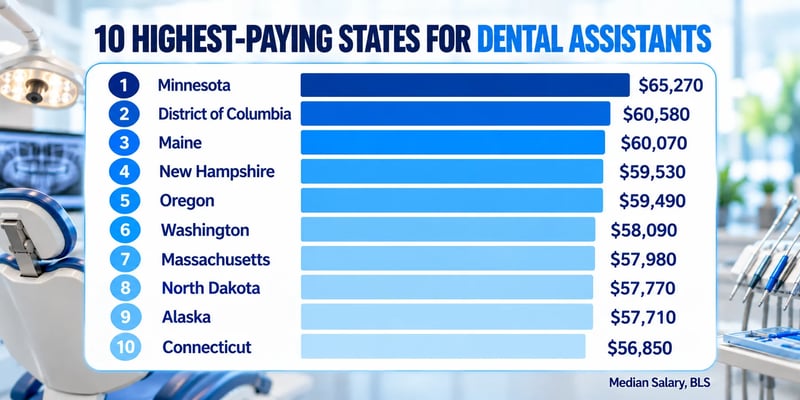
- Minnesota pays the most at $65,270, followed by the District of Columbia, Maine, New Hampshire and Oregon. San Jose ($74,600) and Minneapolis ($72,370) are the highest-paying metros.
- Raises are small unless you add a credential or a role: 46% of dental assistants received a raise in the past 12 months, and the typical raise was 1% to 3% (DANB, 2026).
How Much Does a Dental Assistant Make?
The median dental assistant salary is $48,070 a year, or $23.11 an hour, according to the BLS Occupational Outlook Handbook for May 2025. Half of all dental assistants earn more than that figure and half earn less, and the full range runs from under $37,130 at the 10th percentile to more than $62,250 at the 90th, a $25,120 spread.
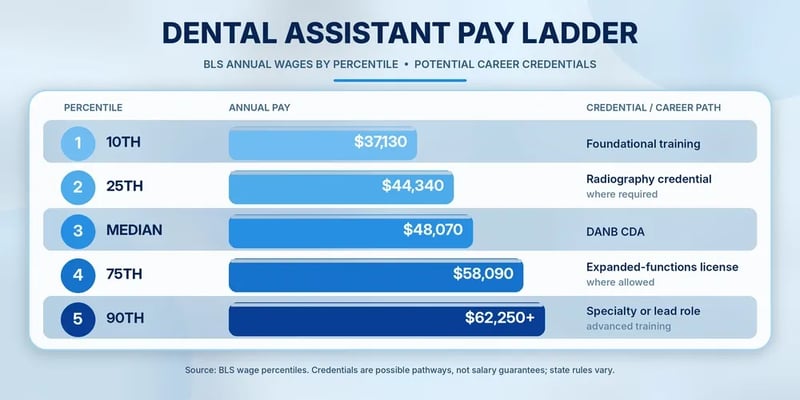
BLS does not sort wages by years of experience, but the Dental Assisting National Board (DANB) survey covered below shows pay rising steadily with tenure, so the percentiles map loosely onto a career: the 10th and 25th percentiles are where new assistants usually start, the median is mid-career territory, and the 75th and 90th percentiles belong to experienced assistants with credentials, expanded duties or a lead role.
Setting moves pay less than state does, because 91% of dental assistants work in dentists' offices. BLS reports these May 2025 medians by setting:
Demand is strong. Dental assistants held 388,600 jobs in 2025, and BLS projects 7% growth through 2035, which it calls much faster than average, with about 53,000 openings a year as people retire or move into other roles.
Dental Assistant Hourly Wage
Both BLS and DANB report dental assistant pay by the hour, so the hourly figures are the ones to bring to an interview. In the BLS wage percentiles published through O*NET, the dental assistant hourly wage runs from $17.85 at the 10th percentile to $29.93 at the 90th, with $21.32 at the 25th, $23.11 at the median and $27.93 at the 75th. At a full-time 2,080 hours, the median works out to about $924 a week and $4,006 a month.
Those figures are straight-time wages and leave out overtime pay and most bonuses. They also sit below the medians in DANB's survey, which reports $28 an hour for CDAs and $24 for assistants who are not certified, because DANB's figures are self-reported by the assistants who answered rather than drawn from the employer payroll survey BLS uses. The two sources tell the same story from different angles: BLS describes the whole field, and DANB describes what certification and tenure add on top of it.
Dental Assistant Salary by State
The widest spread in BLS data is by state. Minnesota's median of $65,270 ($31.38 an hour) leads every other state by more than $4,000, and the District of Columbia ($60,580, or $29.13 an hour), Maine ($60,070, $28.88), New Hampshire ($59,530, $28.62) and Oregon ($59,490, $28.60) round out the top five. Minnesota licenses dental assistants through an accredited program and the CDA exam, and our guide on becoming a dental assistant in Minnesota covers the steps.
Thirteen states and DC pay a median above $50,000. At the other end, Utah ($37,760), West Virginia ($37,960), Alabama ($39,080) and Mississippi ($39,160) pay under $40,000.
The entry and top-earner columns below are where the state picture gets interesting for a career plan. Oregon has the highest starting floor in the country, with the lowest-paid 10% still earning $49,010, and eight states plus DC have entry floors above $45,000. Ohio has the highest ceiling, where the top 10% earn more than $78,000, followed by Minnesota ($76,110), Oregon ($75,570), DC ($74,960) and California ($73,700).
California employs the most dental assistants (56,220) and ranks 14th at $50,110, with a wide spread from $38,790 to $73,700. Its Registered Dental Assistant license sets which duties an assistant can take on, and our guide covers the pathways. Texas is second in jobs (33,230) but ranks 41st at $45,430, and our guide on becoming a dental assistant in Texas covers the radiology certificate required before an assistant can take X-rays there. Florida ranks 28th at $47,620.
Metro areas push the range further. Among the big metros, San Jose-Sunnyvale-Santa Clara pays a median of $74,600 ($35.86 an hour), Minneapolis-St. Paul $72,370 ($34.79), San Francisco-Oakland-Fremont $64,390 ($30.96), Seattle $62,040 and Boston $58,160. Los Angeles has more dental assistant jobs than any metro (21,090) but a median of $46,900, and Houston's $43,730 trails every other large metro.
Minnesota's lead holds up after cost of living, too: on the Bureau of Economic Analysis 2024 price index, Minnesota's prices sit just below the national average while California's run about 11% above it, which leaves California's $50,110 median worth roughly $45,300 in national-average dollars.
Starting Salary
A new dental assistant usually starts between the BLS 10th and 25th percentiles, which puts the entry-level dental assistant salary at $37,130 to $44,340 a year, or $17.85 to $21.32 an hour. In DANB's 2026 Dental Assistants Salary and Satisfaction Survey, assistants with under one year of experience reported a median of $20.93 an hour without certification and $23 with CDA certification, and DANB estimates that a certified entry-level assistant can earn up to $4,000 more a year than one who is not certified.
By the one-to-two-year mark the two groups sit at $22 and $22.50. Three things decide where a first offer lands within that band:
- Your state. The entry floor ranges from $49,010 in Oregon and $47,820 in New Hampshire down to $30,650 in Mississippi and $30,840 in Alabama, so the same first job can pay more than $18,000 more depending on the state line.
- What you can legally do on day one. BLS notes that states typically do not license entry-level dental assistants, but some require a credential before you can take X-rays or perform expanded duties. Walking in with a radiography credential, current CPR and, where it applies, a state registration means a practice can give you a full chairside workload from the first week, which is a fair case for starting above the floor.
- How you trained. Many programs take about a year and lead to a certificate or diploma, according to BLS, and O*NET's education data lists a postsecondary certificate as the most common requirement for the job (46%). Graduates of an accredited program also qualify for the CDA exam right away, while on-the-job trainees need 3,500 hours of work experience first.
If you are weighing offers, use the entry column of the state table above as your floor and the 25th percentile as the number to aim for in your first review.
Mid-Career Pay
Mid-career dental assistants earn around the BLS median of $48,070 ($23.11 an hour) and climb toward the 75th percentile at $58,090 ($27.93 an hour), a $10,020 jump that lines up roughly with DANB's three-to-ten-year brackets. DANB's 2026 brackets show the climb in hourly terms: $24.50 at three to five years, $26.50 at six to ten years and $28 at 11 to 15 years for assistants who are not certified, against $25.23, $27 and $28 for CDAs.
Two patterns in that data are worth planning around. First, the certification gap is wide in the first year ($2.07 an hour), all but disappears between years one and fifteen as experience catches up, then reopens to $3 at 16 to 20 years, so certification matters most when you have the least tenure to point to and again once tenure stops adding on its own.
Second, the curve splits after 15 years: assistants without certification reported a median of $26 at 16 to 20 years, below their 11-to-15-year peak, while CDAs kept rising to $29. In DANB's 2026 data, the CDA is what separates the two groups at that point.
Setting adds a smaller lift. Government employers (excluding schools and hospitals) pay a median of $55,270, more than $7,000 above dentists' offices at $48,000, but they employ only 2% of the field. Expanded duties add a little as well: DANB reports $28.93 an hour for CDAs who perform restorative functions versus $28 for those who do not, and $24 versus $23.50 for assistants who are not certified. The experienced dental assistant salary at this stage, then, is built from three stacked layers: tenure, a credential, and a scope of duties that goes beyond passing instruments.
Senior and Top Earners
The top 10% of dental assistants earn more than $62,250 a year, or $29.93 an hour, in BLS data. DANB's surveys put faces on that bracket: CDAs with 16 to 20 years of experience reported a median of $29 an hour in 2026, lead assistants $30, and in the 2024 survey office managers and practice administrators reported $31.25 while dental assisting educators reported $35.
Top earners cluster in specific places. The 90th percentile tops $70,000 in six states and DC (Ohio, Minnesota, Oregon, DC, California, Massachusetts and North Dakota), and in the San Jose and San Francisco metros the top 10% earn more than $81,710 and $80,660 respectively. Even in a state with a middle-of-the-pack median the ceiling can be high: Cleveland's top 10% earn more than $88,300, the highest of any metro in the country.
Four moves separate the top bracket from the middle:
- A lead role. DANB's 2026 survey found lead assistants earn $2 to $3 more an hour than their colleagues ($30 versus $27 for CDAs, $25 versus $23 for assistants who are not certified).
- Expanded functions. Titles vary by state, from California's Registered Dental Assistant in Extended Functions to Minnesota's Licensed Dental Assistant, Washington's Expanded Function Dental Auxiliary and Oregon's Expanded Function Dental Assistant, but the idea is the same: a credentialed assistant who places restorations, takes impressions or monitors nitrous oxide frees the dentist's chair time, and DANB's data shows a modest premium for it.
- Specialty practices. DANB's 2024 survey found CDAs in periodontics, oral surgery, orthodontics and prosthodontics had the highest wages, and DANB's Certified Orthodontic Assistant credential is the formal route into one of them.
- A move toward the front office. Practice administration is where the $31.25 office manager figure comes from, and the role draws on the scheduling, billing and insurance tasks O*NET already lists for dental assistants.
Skills That Raise Pay
The skills that lift dental assistant pay are mostly the ones that let a dentist delegate more of the appointment, and the ones that come with a credential. These are the skills that show up in DANB's data, state practice acts and O*NET's task list for dental assistants, with the pay effect where a source quantifies it.
- DANB certification. The CDA is the credential with the clearest pay signal: $28 an hour versus $24 in 2026, up to $4,000 a year at entry level, and a steadier climb after 15 years. CDAs were also much more likely to describe themselves as very confident in their work (76% versus 48%), and DANB's data ties confidence to pay, with very confident assistants reporting $28 an hour against $21.98 for those who were only a little confident.
- Radiography. Taking X-rays is the first duty many states regulate, and BLS gives radiography as its example of a task that may require a license. California requires a 32-hour radiation safety course, Texas requires a dental assistant radiology certificate from the State Board of Dental Examiners before an assistant can position or expose X-rays, and Florida certifies dental radiographers after three months of supervised training and a course. The DANB Radiation Health and Safety exam is one of the three components of the CDA, and Texas, for one, lets DANB-certified assistants skip its course and take only the jurisprudence exam.
- Expanded and restorative functions. Under Minnesota's dental assistant rules, a Licensed Dental Assistant can take impressions, place temporary fillings, apply sealants and perform restorative procedures, and with additional certificates can administer nitrous oxide and certain local anesthesia. Washington's Expanded Function Dental Auxiliary license requires an approved expanded-function program plus written and clinical restorative exams. North Carolina splits the job into DA I and DA II, which our guide on becoming a dental assistant in North Carolina breaks down. In every case the expanded functions dental assistant salary premium comes from the dentist's time you free up.
- Preventive functions. Coronal polishing, sealants and fluoride applications are the duties behind DANB's Certified Preventive Functions Dental Assistant credential and California's RDA coursework (12 hours of coronal polishing and 16 hours of sealants). Unlicensed assistants in California cannot place sealants at all, which makes this a credential that visibly widens an assistant's scope.
- Practice software and front-office skills. O*NET flags Henry Schein Dentrix as a hot technology that employers request most often and also lists Patterson EagleSoft, and its task list includes scheduling, billing, insurance forms and inventory. Assistants who can run the schedule as well as the chair are natural candidates for lead and coordinator roles.
- Lab and impression skills. Preliminary impressions, pouring and trimming study casts, and fabricating temporary restorations are all on O*NET's task list, and the impressions and temporaries exams are two of the four components of DANB's restorative functions credential.
The certified dental assistant salary and the registered dental assistant salary are really the same story told by two issuers, DANB nationally and your state board locally. The table below shows the main credentials, what they cost and what each one unlocks.
Timeline to the Next Pay Bracket
Pay in dental assisting moves in steps rather than a smooth slope, and each step has a trigger you can plan for. The table combines the BLS wage percentiles, DANB's 2026 experience brackets and the eligibility rules for the credentials above.
Raises alone will not carry you from one bracket to the next. In DANB's 2026 survey, 46% of dental assistants had received a raise in the previous 12 months, and the typical raise was 1% to 3%. Dental assistants said a fair increase would be about $4 an hour, or roughly 15%, and about one in five had changed jobs in the past year, with better pay among the top three reasons.
A credential or a new role changes the math in a way an annual review rarely does, and the hiring market supports asking: in the ADA Health Policy Institute's third-quarter 2026 report, 76.8% of dentists recruiting assistants called it very or extremely challenging, up from 69.2% a year earlier.
If you are at the start of the ladder, the quickest step is finishing a program that makes you CDA-eligible on graduation day. Dreambound lets you compare dental assistant schools near you by length, cost and schedule.